
PCI DSS Compliance Services UAE 2026
Gap Assessment · Quarterly ASV Scanning · QSA Audit Support · v4.0 Readiness
Serving merchants, payment processors, banks, and fintech companies across UAE, GCC, India, and APAC. All engagements are delivered by certified practitioners — ISA-qualified consultants with direct QSA assessment experience.
⚠ PCI DSS v4.0 Update: All 64 “best practice” requirements became mandatory on April 1, 2025. Organisations still operating under v3.2.1 controls are now non-compliant. If your last assessment was before April 2025, you need an urgent gap review.
Three Ways We Help You Achieve and Maintain PCI DSS Compliance
eShield IT delivers end-to-end PCI DSS compliance support across the full certification lifecycle — from your first gap assessment through quarterly ASV scans and annual QSA audit support. All three services are available independently or as a bundled compliance retainer.
🔍 PCI DSS Gap Assessment
A structured review of your current environment against all applicable PCI DSS v4.0 requirements. We identify every gap between where you are and where you need to be — before your QSA does.
- Full scoping and CDE (Cardholder Data Environment) definition
- Control-by-control assessment against v4.0 requirements
- Risk-rated gap register with remediation priorities
- SAQ selection guidance (A, B, C, D, or custom)
- Remediation roadmap with estimated effort and cost
Indicative cost: AED 8,000 – 18,000
Scope-dependent. Includes written report and debrief session.
📡 Quarterly ASV Scanning
PCI DSS Requirement 11.3.2 mandates quarterly external vulnerability scans by an Approved Scanning Vendor (ASV). We run compliant ASV scans and deliver the passing scan reports you need for your SAQ or RoC submission.
- Quarterly external vulnerability scans (all 4 per year)
- PCI SSC-compliant scan reports for SAQ/RoC submission
- Remediation guidance for any failing findings
- Dispute handling and rescan at no additional cost
- Scan history maintained for audit trail
Indicative cost: AED 4,500 – 9,000/year
Annual retainer covering all 4 mandatory quarterly scans.
📄 QSA Audit Support & RoC
For Level 1 merchants and service providers requiring a formal Report on Compliance (RoC), we provide ISA-qualified consultants who work alongside your QSA to prepare evidence, coordinate interviews, and resolve findings.
- Pre-assessment evidence preparation and organisation
- ISA-qualified consultant embedded with your team
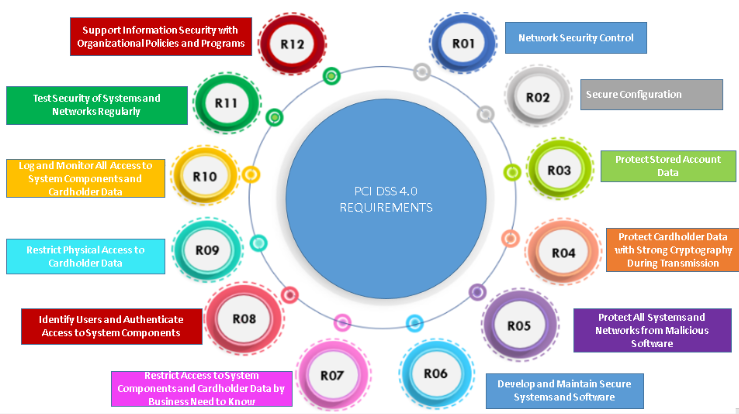
- Control testing support across all 12 PCI DSS domains
- Compensating control design and documentation
- Post-assessment remediation and re-validation
Indicative cost: AED 25,000 – 85,000
Depends on merchant level, environment size, and current maturity.
Who We Serve: Industries and Merchant Types
PCI DSS applies to any organisation that stores, processes, or transmits payment card data — regardless of size, transaction volume, or geography. We work with the following types of organisations across the UAE, GCC, India, and APAC:
| Organisation Type | Typical Scope | Merchant Level | Service Needed |
|---|---|---|---|
| E-commerce merchants (UAE/GCC) | Online card-not-present transactions | Level 2–4 | Gap Assessment + ASV Scanning + SAQ A-EP or C |
| Payment processors | Full cardholder data environment | Level 1 | Gap Assessment + QSA Support + RoC |
| Banks & financial institutions | Issuing, acquiring, core processing | Level 1 | Full compliance program + ongoing ASV |
| Fintech companies (GCC/India) | Payment APIs, wallets, BNPL | Level 2–3 | Gap Assessment + SAQ + ASV Scanning |
| Hospitality & retail chains | POS systems, in-person payments | Level 2–4 | SAQ B-IP or C + ASV Scanning |
| Healthcare providers | Patient billing, co-payments | Level 3–4 | SAQ A + scoping support |
| SaaS/cloud service providers | Shared infrastructure, tokenisation | Service Provider | Gap Assessment + RoC or SAQ D-SP |
Regional Regulatory Context
PCI DSS compliance intersects with local regulatory requirements across our operating regions. Understanding both the global PCI DSS standard and local mandates is essential — and where many compliance programmes fail.
🇺🇦 UAE & GCC
The Central Bank of UAE (CBUAE) mandates PCI DSS compliance for all licensed payment service providers and card-issuing banks. The ADGM and DIFC frameworks reference PCI DSS for regulated fintech entities. In Saudi Arabia, SAMA’s Cyber Security Framework and the SAMA Open Banking Framework both require payment security standards aligned with PCI DSS. In Kuwait (CBK) and Bahrain (CBB), payment processor licences require current PCI DSS attestation.
🇮🇳 India
The Reserve Bank of India (RBI) requires PCI DSS compliance for all payment aggregators and payment gateways under the Payment Aggregator Guidelines (March 2020). NPCI mandates PCI DSS for entities operating on the UPI, NACH, and IMPS networks. Visa and Mastercard acquirer mandates require all Indian merchants above Level 3 to submit annual SAQs and quarterly ASV scan reports. The DPDP Act 2023 adds data localisation and breach notification obligations that intersect with PCI DSS Requirement 12.
🌞 APAC
In Singapore, the Monetary Authority of Singapore (MAS) Technology Risk Management (TRM) Guidelines and the Payment Services Act require payment service providers to maintain PCI DSS compliance. In Australia, the Australian Prudential Regulation Authority (APRA) CPS 234 information security standard complements PCI DSS requirements for ADIs and payment processors. Across APAC, Visa and Mastercard acquirer mandates directly require PCI DSS attestation at each merchant level.
Our PCI DSS Compliance Process
Whether you are pursuing PCI DSS compliance for the first time or maintaining an existing certification, our six-step process ensures you reach and sustain compliance efficiently — without over-scoping or unnecessary remediation spend.
| Phase | What We Do | Output | Typical Duration |
|---|---|---|---|
| 1. Scoping | Define cardholder data flows, identify CDE systems, map network segmentation, determine merchant level | Scoping document and data flow diagram | 1–2 weeks |
| 2. Gap Assessment | Control-by-control review against all applicable PCI DSS v4.0 requirements and sub-requirements | Risk-rated gap register and remediation roadmap | 2–4 weeks |
| 3. Remediation Support | Technical and process remediation guidance across network, application, and policy controls | Closed gap register, policy templates, configurations | 4–12 weeks |
| 4. SAQ / Pre-RoC | SAQ completion support (A through D) or pre-assessment evidence package for QSA | Completed SAQ or RoC-ready evidence folder | 2–4 weeks |
| 5. ASV Scanning | Quarterly external vulnerability scans of all internet-facing CDE IPs, with passing reports for submission | 4× PCI-compliant quarterly scan reports/year | Ongoing quarterly |
| 6. Maintain | Continuous compliance monitoring, change advisory, annual re-assessment, and penetration test coordination | Certificate of compliance renewal, updated RoC | Annual cycle |
PCI DSS v4.0: What Changed and What You Must Act On Now
PCI DSS version 4.0 was published in March 2022. The transition period ended on March 31, 2024. As of April 1, 2025, all 64 requirements previously designated as “best practices” are now fully mandatory. Key changes that most organisations have not yet fully implemented:
- Requirement 6.4.3 & 11.6.1 — Script inventory and integrity monitoring: All payment page scripts must be inventoried, justified, and protected against unauthorised modification. This directly impacts e-commerce merchants using third-party payment widgets.
- Requirement 8.4.2 — MFA for all CDE access: Multi-factor authentication is now mandatory for all access into the cardholder data environment — including from internal networks, not just remote access.
- Requirement 10.7 — Automated audit log monitoring: Automated mechanisms to detect and alert on failures of critical security controls are now required, not optional.
- Requirement 12.3.2 — Targeted risk analysis: Each “customised approach” control now requires a formal targeted risk analysis to justify its design and effectiveness.
- Requirement 12.9.2 — Service provider acknowledgements: All third-party service providers in scope must provide written acknowledgement of their PCI DSS responsibilities annually.
Our v4.0 gap assessment specifically tests for all 64 newly mandatory requirements and produces a prioritised remediation plan focused on the highest-risk gaps.
Why Businesses Choose eShield IT for PCI DSS
- ISA-qualified consultants — our leads hold Internal Security Assessor (ISA) credentials from PCI SSC
- QSA experience — direct experience supporting Level 1 merchant and service provider assessments
- v4.0 specialists — we have assessed against v4.0 since its release; no learning curve at your cost
- Dual-region expertise — practitioners fluent in both UAE/GCC regulatory context and India RBI/NPCI requirements
- Scope reduction focus — we minimise your compliance burden before assessment begins, reducing remediation cost
- Fixed-price gap assessments — no hourly billing surprises; scope agreed upfront with a capped price
- Integrated VAPT — PCI DSS Req 11.3 penetration testing delivered by the same team, no third-party coordination needed
- Retest guarantee — all remediation retesting included at no additional charge
Frequently Asked Questions — PCI DSS Compliance UAE & GCC
What is PCI DSS and who must comply in the UAE?
PCI DSS (Payment Card Industry Data Security Standard) is a global security standard mandated by Visa, Mastercard, Amex, and other card brands for any organisation that stores, processes, or transmits payment card data. In the UAE, the Central Bank of UAE (CBUAE) requires all licensed payment service providers and card-issuing banks to maintain current PCI DSS compliance. Any UAE or GCC merchant accepting card payments — online or in-store — is subject to their acquirer’s PCI DSS compliance requirements.
What is a PCI DSS gap assessment?
A PCI DSS gap assessment is a structured review that compares your current security controls, processes, and policies against every applicable PCI DSS v4.0 requirement. The output is a gap register that identifies exactly what is missing or insufficient, the risk level of each gap, and a prioritised remediation roadmap. A gap assessment is typically the first step for any organisation beginning its PCI DSS journey and is strongly recommended before engaging a formal QSA.
What is ASV scanning and is it mandatory?
An Approved Scanning Vendor (ASV) is a company certified by the PCI Security Standards Council to conduct external vulnerability scans of internet-facing systems in the cardholder data environment. PCI DSS Requirement 11.3.2 mandates quarterly ASV scans for all merchants and service providers who maintain systems with direct connections to the internet. Scans must produce a “passing” report — showing no high-severity unresolved vulnerabilities — before submission to your acquirer or QSA. Skipping ASV scans is one of the most common reasons PCI DSS compliance attestations are rejected.
What SAQ type does my business need?
The correct Self-Assessment Questionnaire (SAQ) depends on how your business processes card data. SAQ A applies if you fully outsource payment processing and have no cardholder data on your systems. SAQ A-EP applies to e-commerce merchants using JavaScript-based payment forms. SAQ B-IP covers merchants using standalone IP-connected POS terminals. SAQ C applies to payment application systems with internet connectivity. SAQ D is the most comprehensive, required for service providers and merchants that store cardholder data. Our gap assessment includes SAQ selection guidance as a standard deliverable.
How long does PCI DSS compliance take in UAE?
For a Level 3–4 merchant using a fully outsourced payment processor (SAQ A), PCI DSS compliance can be achieved in 3–6 weeks — primarily gap assessment and SAQ completion. For a Level 2 merchant with an in-house payment application (SAQ C or D), expect 8–16 weeks including remediation. Level 1 merchants requiring a formal Report on Compliance (RoC) typically require 4–9 months for the full assessment cycle. The largest variable is your current security maturity — organisations with ISO 27001 controls in place typically reach PCI DSS compliance significantly faster.
What does PCI DSS compliance cost in UAE and India?
For UAE businesses, indicative costs: Gap Assessment AED 8,000–18,000; Annual ASV Scanning AED 4,500–9,000; SAQ completion support AED 6,000–14,000; full QSA audit support AED 25,000–85,000. For India, equivalent services in INR typically range from ₹2,50,000–₹6,00,000 for gap assessment and ₹12,00,000–₹40,00,000 for full RoC support. All prices depend on environment size, merchant level, and current security maturity. Contact us for a scoped, fixed-price proposal.
Can eShield IT support Level 1 merchant assessments?
Yes. Our ISA-qualified consultants have direct experience supporting Level 1 merchant and service provider assessments across banking, fintech, and e-commerce environments in UAE, GCC, and India. We work alongside the QSA as your internal compliance team — preparing evidence packages, coordinating stakeholder interviews, and resolving findings before they become RoC observations.
Does PCI DSS compliance satisfy UAE CBUAE requirements?
PCI DSS compliance satisfies the payment security requirements of the CBUAE Retail Payment Services and Card Schemes Regulation and the CBUAE Cybersecurity Framework for payment service providers. However, CBUAE also has additional requirements around incident reporting (within 4 hours of a material cybersecurity incident), VAPT frequency, and Board-level cybersecurity governance that go beyond PCI DSS scope. Our UAE compliance engagements address both PCI DSS and CBUAE-specific requirements concurrently.
Ready to Start Your PCI DSS Compliance Journey?
Tell us your merchant level, geography, and timeline. We will respond within one business day with a scoped proposal.