


Introduction
Digital communication once relied on a simple assumption: what you see is real. Today, that assumption no longer holds. Deepfakes and AI-generated content are transforming how information is created, shared, and consumed. While innovation brings efficiency and creativity, it also introduces a growing trust crisis.
Deepfakes and AI content now influence business communication, media reporting, political messaging, and social interaction. As a result, distinguishing authentic information from synthetic manipulation becomes increasingly difficult. Consequently, organisations and individuals must rethink how they verify digital truth.
In 2026, the risk is not just misinformation. The deeper issue is erosion of trust itself.
What Are Deepfakes and AI-Generated Content?
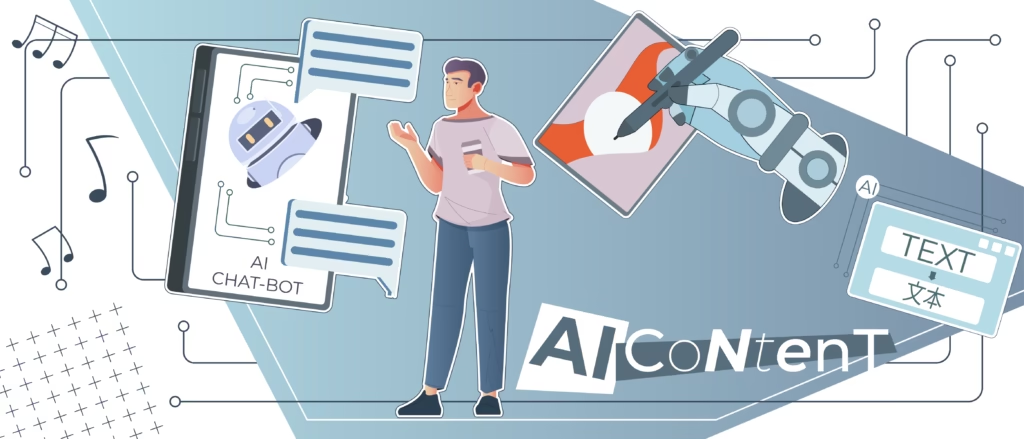
Deepfakes are synthetic media created using artificial intelligence to mimic real people’s faces, voices, or expressions. AI-generated content, meanwhile, includes text, images, audio, and video produced by machine learning models.
For example:
- AI can generate a CEO’s voice to imitate an internal call.
- A video can depict a public figure saying something they never said.
- A realistic email can be written in seconds to impersonate a trusted executive.
Because these outputs appear authentic, users often accept them without suspicion.
Deepfakes rely on neural networks trained on real-world data. Meanwhile, AI-generated text systems analyse language patterns to produce human-like responses. Although these technologies have legitimate uses, they also enable large-scale deception. Read more
How Deepfakes and AI Content Undermine Trust
Trust in digital environments depends on authenticity. However, AI-generated media challenges that foundation.
Visual Manipulation
Video evidence once carried significant credibility. Now, manipulated footage can appear convincing.
Voice Cloning
Attackers can replicate speech patterns and accents with minimal training data.
Automated Social Engineering
AI can craft highly personalised phishing emails or messages at scale.
Rapid Content Generation
False narratives can spread faster than fact-checking mechanisms can respond.
Because of these capabilities, users increasingly question what they see and hear.
Real-World Scenario: Executive Impersonation
Imagine a multinational company where the finance team receives a video call from someone appearing to be the CEO. The voice sounds correct. The face matches perfectly. The executive urgently requests a confidential financial transfer.
The team complies.
Later, investigators discover that the call was a deepfake. No systems were breached. No passwords were stolen. Instead, attackers exploited synthetic media to bypass human verification.
This scenario illustrates how deepfakes shift the threat landscape from technical compromise to psychological manipulation.
Why This Crisis Is Growing in 2026
Several factors accelerate the digital trust crisis.
Lower Barriers to Entry
AI tools are widely accessible. Consequently, advanced manipulation no longer requires technical expertise.
Increased Remote Communication
Organisations rely heavily on digital meetings, recorded messages, and asynchronous communication.
Information Overload
Users process massive volumes of content daily. Therefore, verification fatigue sets in.
Blurring of Real and Synthetic
AI-generated marketing, art, and communication blur authenticity lines further.
Because these conditions persist, the risk continues to grow.
Impact on Businesses
For organisations, deepfakes and AI content create tangible security challenges.
- Financial fraud through executive impersonation
- Brand reputation damage
- Manipulated press statements
- Disinformation targeting stock value
- Customer trust erosion
Moreover, incident response becomes more complex when media authenticity is disputed.
Ultimately, businesses must treat synthetic media risk as part of cybersecurity strategy.
Impact on Governments and Society
Beyond corporate risk, societal trust faces erosion.
- Election interference through fabricated speeches
- Manipulated crisis communication
- False emergency alerts
- Viral misinformation campaigns
When citizens doubt legitimate communication, governance stability weakens. Therefore, protecting information integrity becomes essential.
Why Detection Alone Is Not Enough
Although detection tools are improving, they cannot fully solve the problem.
AI Evolves Rapidly
As detection improves, generation techniques adapt.
Authentic Media Can Be Questioned
The “liar’s dividend” effect allows individuals to dismiss real evidence as fake.
Scale Overwhelms Review Systems
Automated content spreads faster than manual verification can manage.
Consequently, defence must extend beyond detection.
How Organisations Can Reduce Deepfake Risk
Mitigation requires layered strategies.
Multi-Factor Verification
High-value actions should require multiple authentication methods.
Voice and Video Confirmation Protocols
Sensitive requests should follow structured validation steps.
AI Content Governance Policies
Clear policies must define acceptable AI usage within organisations.
Employee Awareness Training
Teams must understand that synthetic media can appear highly convincing.
Crisis Communication Planning
Prepared response strategies reduce confusion during incidents.
By embedding verification into workflow, organisations strengthen resilience.
Building a Culture of Verification
Deepfakes and AI content demand behavioural change.
Instead of relying solely on perception, organisations should implement confirmation procedures for critical actions. For example, financial approvals may require independent channel verification.
Similarly, executives should establish clear communication protocols for urgent requests. When procedures become routine, attackers lose the advantage of surprise.
Trust should not disappear. However, blind trust must evolve into structured verification.
The Long-Term Trust Challenge
As AI-generated content becomes normalised, society faces a paradox. On one hand, synthetic tools enhance productivity and creativity. On the other hand, they destabilise confidence in authenticity.
Therefore, the digital trust crisis is not temporary. It represents a structural shift in how communication functions.
Businesses, governments, and individuals must adapt accordingly.
Conclusion
Deepfakes and AI content are reshaping digital communication. While these technologies offer powerful benefits, they also create a growing trust crisis. As synthetic media becomes more convincing, the risk shifts from system compromise to perception manipulation.
In 2026, protecting digital trust requires structured verification, awareness, and governance. At eSHIELD IT Services, we help organisations assess emerging threats linked to AI-driven deception and strengthen resilience before manipulation escalates into financial or reputational damage.
Innovation should enhance communication, not undermine credibility.
FAQ
What are deepfakes?
Deepfakes are AI-generated videos or audio that mimic real people.
Is AI-generated content always malicious?
No. It has legitimate uses but can be abused.
How do deepfakes affect businesses?
They enable fraud, impersonation, and reputational damage.
Can deepfakes be detected reliably?
Detection tools exist, but attackers continuously adapt.
What is voice cloning?
It uses AI to replicate a person’s speech patterns.
Are elections at risk from deepfakes?
Yes, synthetic media can influence public perception.
What is the liar’s dividend?
It is when real evidence is dismissed as fake.
Can small businesses be targeted?
Yes, especially through executive impersonation fraud.
How can organisations reduce risk?
By implementing multi-step verification and awareness training.
Will deepfake threats increase?
Yes, as AI tools become more accessible.
