

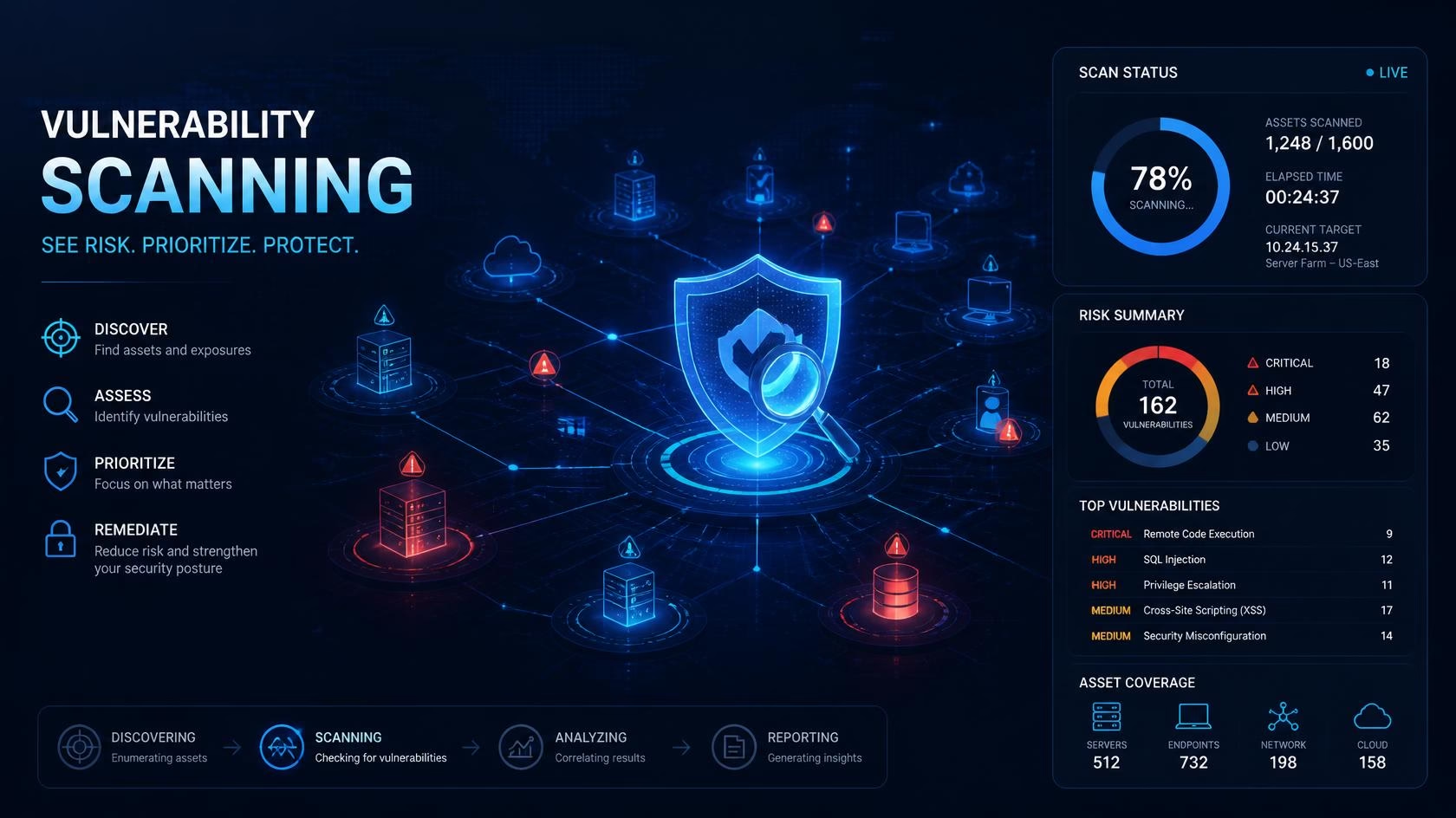

Protecting corporate assets in the United Arab Emirates requires a proactive mindset in today’s fast-changing digital world. Many businesses treat security checks as a one-time event, but true safety needs a structured, recurring approach to risk management.
Eshielditservices provides a complete framework to help your organization plan and perform effective vulnerability scanning. By adding these assessments to daily operations, you move beyond technical tasks and build a robust security culture.
Our process guides your team through each key stage, from initial asset discovery to final remediation. We use ongoing oversight and expert analysis to keep your infrastructure resilient against emerging threats. This systematic method helps UAE firms maintain compliance and protect their most valuable data assets.
Key Takeaways
- Establish a recurring security schedule to maintain consistent protection.
- Utilize Eshielditservices for end-to-end asset discovery and risk assessment.
- Prioritize remediation efforts based on the severity of identified threats.
- Ensure continuous oversight to adapt to the changing UAE cyber landscape.
- Transform security from an isolated task into a core business practice.
Prepare Your UAE Organization for Vulnerability Scanning
Good planning supports a reliable network security assessment in the UAE. Eshielditservices aligns each technical check with local regulatory standards and operational goals.
Step 1: Define the Security Assessment Scope
List public-facing websites, internal networks, endpoints, cloud assets, and business applications
First, identify every digital asset that needs protection. A complete inventory helps your vulnerability scanning efforts find every critical system.
Separate production, development, and third-party environments before scanning
Separate these environments to prevent downtime during testing. Clear segmentation helps Eshielditservices target high-risk areas without affecting live business services.
Step 2: Confirm Authorization and Business Requirements
Obtain written approval for testing systems and handling security findings
Written approval supports legal compliance during testing. It protects your team and shows stakeholders the approved scope of the network security assessment.
Account for UAE data protection, sector requirements, and business continuity obligations
Your plan must follow UAE data sovereignty laws and industry mandates. Eshielditservices balances thorough testing with uninterrupted business continuity across the UAE.
Step 3: Gather Asset and Contact Information
Record IP addresses, domain names, cloud accounts, application owners, and maintenance windows
Accurate technical data makes each scan more precise and efficient. An updated asset list helps you track changes and manage your vulnerability scanning schedule.
Identify technical contacts for urgent vulnerability notifications
Fast communication matters when critical security gaps appear. A clear contact lets your team respond to high-priority findings from the network security assessment.
Configure an Eshielditservices Vulnerability Scanning Engagement
Properly configuring a vulnerability scan builds a strong security posture in the UAE. Matching your technical needs with Eshielditservices expertise produces useful results and protects daily operations.
Step 1: Select the Appropriate Assessment Type
Choose network security assessment coverage for infrastructure and connected devices
A comprehensive network security assessment finds weaknesses across internal and external infrastructure. It covers servers, routers, switches, and connected endpoints, helping protect your perimeter from unauthorized access.
Request web application testing for websites, portals, and application interfaces
Modern businesses depend on digital platforms. Targeted web application testing finds flaws in custom portals, APIs, and customer-facing interfaces that network scans may miss.
Include cloud security posture checks for cloud accounts and hosted resources
As organizations move to the cloud, a strong cloud security posture becomes critical. Eshielditservices reviews cloud settings for mismanaged permissions, exposed storage buckets, and other common cloud risks.
| Assessment Type | Primary Focus | Key Benefit |
|---|---|---|
| Network | Infrastructure & Hardware | Perimeter Hardening |
| Web Application | Portals & APIs | Data Breach Prevention |
| Cloud | Hosted Environments | Configuration Compliance |
Step 2: Define Scanning Credentials and Access Rules
Prepare least-privilege credentials for an authenticated assessment
For deeper visibility, an authenticated assessment is highly recommended. Providing least-privilege credentials lets the scanner inspect internal settings without giving unnecessary administrative control.
Specify permitted scan sources, firewall rules, VPN access, and rate limits
Define the engagement’s technical boundaries for smooth operations. List permitted scan sources, and update firewall rules or VPN access so Eshielditservices can reach your assets. Keep strict rate limits to prevent performance problems.
Step 3: Set Safe Scanning Parameters
Schedule scans during approved periods to reduce service disruption
Timing helps maintain business continuity. Schedule scans during off-peak hours or approved maintenance windows to minimize possible effects on daily operations.
Exclude fragile systems or use lower-impact checks when necessary
Some legacy or sensitive systems may be fragile. If critical hardware cannot handle standard traffic, tell the team to exclude it or use lower-impact checks.
Confirm how Eshielditservices will handle discovered sensitive information
Clear data-handling rules are a priority. Confirm the protocols Eshielditservices follows to protect sensitive information found during the process. This supports full compliance with local data protection regulations.
Run the Initial Vulnerability Scanning
Eshielditservices offers a clear framework for starting your initial vulnerability scanning process with care. This phase turns preparation into useful data and helps protect your digital environment from new threats.
Step 1: Validate Connectivity Before the Full Scan
Check that approved hosts, applications, and cloud assets are reachable
Before a full-scale network security assessment, confirm that every target system answers probe requests. These checks show whether firewalls or network segments block the scanner and cause incomplete results.
Verify that authentication works without exposing administrative credentials
Testing credentials early prevents access errors during the scan. Confirm that the scanner can log in with only the privileges it needs.
Step 2: Start Discovery and Vulnerability Detection
Identify open ports, services, operating systems, software versions, and exposed interfaces
After confirming connectivity, the engine maps your digital footprint. Discovery finds each active service and operating system version across your UAE-based infrastructure.
Detect missing patches, insecure protocols, unsupported software, and known weaknesses
The system compares discovered assets with global threat databases. It flags serious gaps, including outdated software and protocols that fail modern security standards.
Step 3: Monitor the Assessment for Safety and Coverage
Review scan status, unreachable assets, authentication failures, and unexpected alerts
Active monitoring helps protect normal operations. Watch the dashboard to confirm the scan covers every intended asset without creating false alarms.
Pause or adjust testing if performance degradation or service instability occurs
If business-critical applications suffer any impact, pause the scan at once. Adjusting the intensity or timing of the vulnerability scanning helps balance security with performance.
Step 4: Record the Scan Baseline
Save the assessment date, scope, scan profile, credentials used, and exclusions
Record the first scan’s date, scope, scan profile, credentials used, and exclusions. These details create a reliable reference for future security improvements.
Use the baseline to compare future vulnerability scanning results
Compare new data with this baseline to track progress over time. This network security assessment strategy helps measure your remediation efforts clearly.
| Scan Phase | Primary Objective | Success Metric |
|---|---|---|
| Connectivity | Verify reachability | 100% host response |
| Discovery | Map assets | Full inventory list |
| Detection | Identify risks | Zero critical gaps |
| Baseline | Establish reference | Consistent data set |
Review Findings Using CVE Databases and CVSS Risk Ratings
Turning raw scan data into useful security intelligence requires a clear review process. Eshielditservices provides detailed reports, but your team must check them before making decisions. This process directs limited resources toward the most critical security gaps.
Step 1: Validate Each Reported Vulnerability
Match software and version details with relevant CVE databases
Start by checking the software versions found during your scan. Compare these details with official cve databases to confirm known flaws. This prevents wasted effort on outdated or incorrect alerts.
Distinguish confirmed vulnerabilities from informational findings and potential false positives
Not every alert signals an active threat to your environment. Filter out informational findings that pose no risk. Careful validation separates real vulnerabilities from potential false positives that could distract your IT team.
Step 2: Interpret CVSS Risk Ratings in Context
Use severity, exploitability, attack complexity, and required privileges to assess urgency
Technical scores offer a starting point, but they do not show the full picture. Evaluate cvss risk ratings by checking severity, exploitability, and attack complexity. The privileges an attack needs help determine how soon to apply a patch.
Consider internet exposure, business criticality, sensitive data, and threat activity
A high-severity score on an isolated system may be less urgent than a medium score on a public-facing server. Consider internet exposure, business criticality, sensitive customer data, and current threat activity. This context helps align your response with actual risk levels.
Step 3: Group Findings by Root Cause
Combine duplicate findings caused by one missing patch or insecure configuration
Scanning tools often report one underlying issue across several systems. Group these findings instead of treating every alert as a separate task. Fixing one missing patch across a server cluster is more efficient than handling each alert manually.
Separate technical symptoms from the underlying control failure
Focus on the root cause instead of only the technical symptoms. A single misconfigured firewall rule can trigger dozens of alerts. Fixing the central control failure resolves multiple issues at once.
Step 4: Identify UAE-Specific Business Impact
Prioritize systems supporting finance, government services, healthcare, logistics, and customer data
In the United Arab Emirates, some sectors need extra protection because they support the national economy. Prioritize systems supporting finance, healthcare, and government services. Protecting these assets supports operational continuity and public trust.
Document regulatory, contractual, operational, and reputational consequences
Every vulnerability can cause harm beyond technical failure. Document how a breach could affect regulatory compliance or contractual obligations within the UAE. Understanding these reputational risks helps leaders justify needed security investments.
Perform Authenticated Assessment and Configuration Audits
Beyond basic scans, we uncover hidden risks across your UAE infrastructure. Eshielditservices uses an authenticated assessment to examine your environment closely. This approach clearly shows your actual security state.
Step 1: Compare Authenticated and Unauthenticated Results
Use authenticated assessment data to identify local patches, software versions, and settings
With credentials, our tools log into systems and inspect installed software. This reveals missing patches and outdated versions that external scans often miss. Detailed visibility shows your team which assets need immediate updates.
Explain why external scans may not reveal weaknesses visible from inside the system
External scans see only what the public internet exposes. They cannot find internal misconfigurations or local vulnerabilities that attackers might exploit after gaining access. An internal view is essential for a complete security strategy.
Step 2: Audit Infrastructure Configurations
Review password policies, administrative access, encryption, logging, and remote management
We examine core infrastructure to confirm that security policies work correctly. We check for weak password requirements and unauthorized administrative access. We also verify encryption for all sensitive data transmissions.
Check firewalls, routers, servers, endpoint controls, and network segmentation
Proper configuration audits help verify that your network prevents lateral movement. We review firewall rules and server settings against industry best practices. This confirms that endpoint controls work as intended.
Step 3: Audit Web Application Configurations
Examine access control, session handling, security headers, input validation, and error messages
Our web application testing finds flaws in custom and third-party software. We look for broken access control and improper session management. These checks help prevent common attacks against live services.
Coordinate web application testing with application owners to protect live services
We work with your team so testing does not disrupt business operations. By coordinating with application owners, we safely validate security headers and input validation. This collaborative approach reduces risk and increases assessment value.
Step 4: Review Cloud Security Posture
Check identity permissions, public storage, exposed services, network rules, and logging
A strong cloud security posture is vital for modern UAE organizations. We audit your cloud environment for overly permissive identity roles and exposed storage buckets. We also verify logging to create an audit trail for security events.
Compare cloud configurations with approved security standards and organizational policies
We compare your cloud settings with established security frameworks. This highlights gaps between your current setup and desired security state. Following these standards supports compliance and reduces your attack surface.
| Assessment Type | Visibility Level | Primary Goal | Risk Detection |
|---|---|---|---|
| Unauthenticated | External Only | Perimeter Defense | Low to Medium |
| Authenticated | Full System Access | Internal Hardening | High |
| Configuration Audit | Policy-Based | Compliance Check | Medium to High |
Prioritize Remediation and Track Security Improvements
Eshielditservices helps UAE organizations turn technical data into a measurable security program. Moving beyond discovery helps teams give each weakness the attention it needs. Detailed configuration audits help keep infrastructure resilient against evolving threats.
Step 1: Build a Risk-Based Remediation Plan
Address actively exploitable, internet-facing, and business-critical weaknesses first
Not all vulnerabilities threaten operations equally. Focus limited resources on flaws actively exploited in the wild or found on internet-facing assets. Prioritizing these flaws gives the greatest immediate reduction in your overall attack surface.
Assign an owner, due date, priority, and approved remediation method to each finding
Accountability supports a successful security program. Every finding needs a designated owner responsible for the fix and a clear deadline. Defining the approved method early prevents confusion and keeps fixes aligned with internal security policies.
Step 2: Apply and Verify Security Fixes
Patch vulnerable software, remove unnecessary services, strengthen configurations, and restrict access
Once you identify a weakness, act quickly to reduce the risk. Apply security patches, disable unused services, and harden system settings. These steps help maintain a secure posture across your entire digital environment.
Test changes in a controlled environment before applying them to production
Never deploy a fix directly to live systems without testing it first. Testing changes in a sandbox or staging environment prevents downtime and protects critical business functions.
Step 3: Use Eshielditservices Remediation Tracking
Record status changes, exception approvals, compensating controls, and supporting evidence
Effective remediation tracking helps you keep a clear audit trail of security progress. Documenting every status change and adding evidence gives transparency to stakeholders and auditors.
Escalate overdue critical findings to security and business leadership
When a critical vulnerability remains unpatched after its deadline, management needs immediate notice. Escalation helps leadership understand the business impact and provide resources to resolve the issue.
Step 4: Manage Findings That Cannot Be Fixed Immediately
Document the reason, risk owner, expiration date, and compensating control
Sometimes, a system cannot be patched because of legacy requirements or operational constraints. Document the specific reason for the delay and assign a risk owner. Using compensating controls, such as network segmentation or enhanced monitoring, reduces risk until a permanent fix becomes possible.
Review accepted risks regularly instead of treating them as permanently resolved
Accepting a risk is temporary, not permanent. Schedule regular reviews to see whether the original constraint remains or new technology enables a permanent fix. Ongoing remediation tracking ensures that no vulnerability is forgotten over time.
Rescan Systems and Report Vulnerability Scanning Results
Eshielditservices offers a structured way to confirm your remediation tracking efforts worked. After security updates are complete, the final phase checks that your environment stays protected.
Step 1: Run a Targeted Validation Scan
Rescan affected assets after patches or configuration changes are complete
After applying security patches, run a targeted scan to verify the changes. This vulnerability scanning process confirms the earlier weaknesses are no longer present.
Confirm that the original vulnerability no longer appears under comparable conditions
Use the same scan parameters to keep results consistent. Verification confirms that your systems are protected from the previously identified threats.
Step 2: Investigate Findings That Remain
Check for failed patches, incorrect asset identification, cached results, or compensating controls
A scan may still report a vulnerability after your team applies a fix. Investigate whether the patch failed or the system still uses cached data.
Reopen findings when remediation only reduces exposure without removing the weakness
If a fix only partly addresses the issue, keep the finding open in your remediation tracking system. Confirm that the risk is fully mitigated before marking the item resolved.
Step 3: Create Reports for Different Stakeholders
Provide executives with trends, high-risk exposure, remediation progress, and business impact
Executive reports should show your security posture and the big picture. These summaries highlight progress and the organization’s overall risk reduction.
Give technical teams evidence, affected assets, severity, and recommended corrective actions
Technical teams need detailed data to perform their duties effectively. Clear evidence shows which assets need more attention during vulnerability scanning cycles.
Step 4: Preserve Assessment Evidence
Store reports, scan configurations, validation results, and exception records securely
A detailed audit trail is a critical requirement for compliance. Store all scan configurations and validation results in a secure, centralized location.
Limit access to vulnerability data because it can reveal attack opportunities
Strictly control access to these reports to prevent unauthorized disclosure. Protecting this data matters as much as the remediation tracking process. The reports contain sensitive information about your infrastructure.
Establish a Recurring Vulnerability Management Program
Eshielditservices helps UAE organizations turn static security checks into a dynamic, recurring program. This approach supports a proactive defense against emerging digital threats.
“Security is not a product, but a process that requires constant attention and adaptation to the changing threat landscape.”
— Anonymous Security Expert
Step 1: Set a Repeatable Scanning Schedule
Scan after major infrastructure, application, and cloud changes
When your team deploys software or updates hardware, start a new vulnerability scanning cycle. These changes can create gaps that attackers may exploit.
Schedule recurring internal and external assessments based on organizational risk
Set a schedule based on your organization’s risk profile. High-risk assets need frequent reviews to keep your security posture strong against advanced attacks.
Step 2: Integrate Scanning With Security Operations
Connect findings with patch management, incident response, asset management, and change control
Strong security needs clear links between scanning tools and daily workflows. These links help your team respond to threats and prevent missed critical vulnerabilities.
Use remediation tracking to measure closure rates and recurring weaknesses
Remediation tracking shows how quickly your team fixes issues. This data can reveal deeper weaknesses that need design changes, not just patches.
Step 3: Measure Program Effectiveness
Track mean time to remediate, critical findings, exposed assets, and repeat vulnerabilities
Useful metrics show stakeholders the value of your security program. Mean time to remediate measures work speed and overall risk reduction.
Review trends from CVE databases and changing CVSS risk ratings
Check CVE databases often for new threat information. Changes in CVSS risk ratings help your team address the most dangerous vulnerabilities first.
Step 4: Improve Assessments Over Time
Update scan credentials, asset inventories, exclusions, and testing rules
Your environment changes often, so testing settings must keep up. Updated inventories and rules make vulnerability scanning more accurate and complete.
Coordinate periodic network security assessment, web application testing, and cloud security posture reviews
A mature program uses several focused reviews. Combining a network security assessment, web application testing, and cloud security posture review shows your full digital perimeter.
| Program Feature | Ad-Hoc Scanning | Recurring Program |
|---|---|---|
| Risk Visibility | Limited/Snapshot | Continuous/Real-time |
| Response Speed | Reactive | Proactive |
| Compliance Status | Periodic | Audit-Ready |
| Resource Efficiency | High Overhead | Optimized |
Conclusion
Protecting your organization in the United Arab Emirates requires proactive cyber defense. Eshielditservices can strengthen your security posture through consistent vulnerability scanning.
Each assessment needs clear authorization and a well-defined scope. Accurate asset identification and context-based risk analysis help your team rank threats that matter most to business operations.
Effective security is not a one-time event. It requires controlled remediation, thorough rescanning, and detailed reporting to maintain strong defenses. Eshielditservices helps integrate these practices into your daily operations.
Treating vulnerability scanning as a permanent management process helps keep your infrastructure resilient against evolving threats. Reach out to the Eshielditservices team today to build a measurable, sustainable security program for your organization.
FAQ
How does Eshielditservices initiate a vulnerability scanning engagement for UAE-based organizations?
The process starts by defining a clear security assessment scope. Eshielditservices inventories public-facing websites, internal networks, and cloud assets with your team. Before testing, we obtain formal authorization and match the scan to UAE-specific data protection regulations and business continuity requirements.
What is the difference between a standard scan and an authenticated assessment?
A standard scan finds vulnerabilities from an external view. An authenticated assessment gives Eshielditservices least-privilege credentials. Our tools can then find local patches, outdated software versions, and internal configuration issues hidden from unauthenticated network probes.
How are the results of a network security assessment prioritized?
We use CVSS risk ratings to measure each finding’s technical severity, including exploitability and attack complexity. Eshielditservices compares findings with global CVE databases and your business context. We consider critical infrastructure and sensitive customer data when creating a high-impact remediation roadmap.
Does Eshielditservices provide specialized web application testing?
Yes. Beyond infrastructure, we test web applications for access controls, session handling, and input validation. This helps portals and application interfaces resist modern web-based threats and meet organizational security standards.
How does the service address cloud security posture?
Our assessments include a detailed review of your cloud security posture. Eshielditservices checks identity permissions, public storage configurations, and network rules. We look for misconfigurations that could expose data or allow unauthorized access.
How is remediation tracking managed after a scan is completed?
Eshielditservices provides a structured remediation tracking framework. We assign owners and due dates, verify fixes through targeted rescanning, and document compensating controls. This makes security improvements measurable and accountable when risks cannot be fixed immediately.
What role do configuration audits play in the scanning process?
Configuration audits find “soft” security weaknesses, such as weak password policies, insecure logging practices, or unnecessary services. Eshielditservices compares system settings with industry benchmarks and internal policies. This helps hardened systems resist exploitation.
How does Eshielditservices ensure that vulnerability scanning doesn’t disrupt business operations?
We schedule assessments during approved maintenance windows and limit network traffic with rate limits. Eshielditservices coordinates with technical contacts to monitor system stability in real-time. We can pause or adjust scanning if performance degradation appears.
Why is it important to integrate CVE databases into the reporting process?
Eshielditservices matches discovered weaknesses with CVE databases to provide standardized, verified intelligence. The findings are not merely “theoretical”; documented evidence supports each security flaw. This helps teams identify the correct patches and remediation steps.
How often should an organization perform a network security assessment?
Eshielditservices recommends a recurring schedule based on your risk profile. Many UAE organizations perform quarterly scans. We also advise scanning after major infrastructure changes, new application deployments, or significant new threats enter global CVE databases.
