
Security | Privacy | Compliance
Security | Privacy | Compliance
PCI DSS Compliance Services in Dubai & UAE
eShield helps UAE merchants, banks, fintechs and payment service providers become PCI DSS compliant and stay that way. We handle the whole process: scope reduction, a gap assessment against PCI DSS v4.0.1, remediation, SAQ completion and support through your QSA assessment, all from our Dubai team.
Get a Free PCI Scoping Call → Chat on WhatsAppTeam: PCI DSS implementation specialists · OSCP pentesters · ISO 27001 Lead Auditors | Office: Oud Metha, Dubai
What Is PCI DSS and Who Needs It in the UAE?
The Payment Card Industry Data Security Standard (PCI DSS) is the global security standard from the PCI Security Standards Council for any organisation that stores, processes or transmits payment card data. It is enforced through the card brands (Visa, Mastercard, Amex) and your acquiring bank. If you fall short, you can face fines from your acquirer, higher transaction fees, or lose the ability to accept cards.
In the UAE, PCI DSS applies to:
- Merchants: e-commerce stores, retailers, hotels, restaurants and anyone accepting card payments.
- Banks & financial institutions: card issuers and acquirers regulated by the Central Bank of the UAE (CBUAE).
- Payment service providers & fintechs: gateways, wallets, BNPL and card-issuing platforms.
- Service providers: hosting, data centres, call centres and SaaS platforms that touch card data for their clients.
Important update: PCI DSS v4.0.1 is now the only active version. PCI DSS v3.2.1 was retired on 31 March 2024 and v4.0 on 31 December 2024. Since 31 March 2025, all 51 “future-dated” v4.x requirements are mandatory. These include MFA for all access to the cardholder data environment, payment-page script management (6.4.3), change-detection on payment pages (11.6.1) and targeted risk analyses. If your last assessment was against an older version, you need a delta gap assessment.
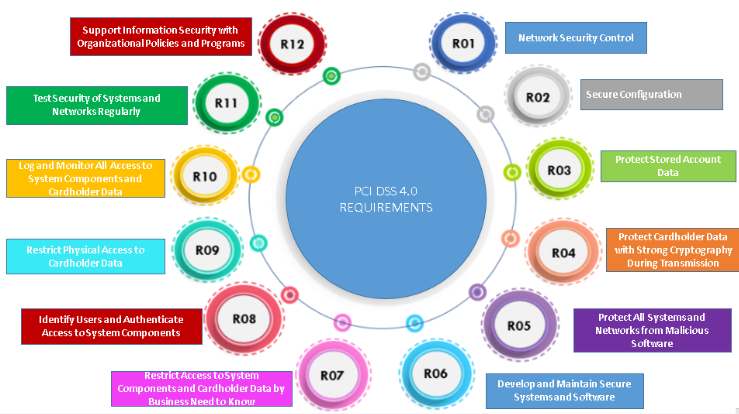
The 12 PCI DSS v4.0.1 Requirements
| Goal | # | Requirement |
|---|---|---|
| Build and maintain a secure network and systems | 1 | Install and maintain network security controls |
| 2 | Apply secure configurations to all system components | |
| Protect account data | 3 | Protect stored account data |
| 4 | Protect cardholder data with strong cryptography during transmission over open, public networks | |
| Maintain a vulnerability management program | 5 | Protect all systems and networks from malicious software |
| 6 | Develop and maintain secure systems and software | |
| Implement strong access control measures | 7 | Restrict access to system components and cardholder data by business need to know |
| 8 | Identify users and authenticate access to system components | |
| 9 | Restrict physical access to cardholder data | |
| Regularly monitor and test networks | 10 | Log and monitor all access to system components and cardholder data |
| 11 | Test security of systems and networks regularly | |
| Maintain an information security policy | 12 | Support information security with organisational policies and programs |
Merchant Levels and How Compliance Is Validated
PCI DSS is not an ISO-style certificate. Compliance is validated every year, either with a Self-Assessment Questionnaire (SAQ) or a Report on Compliance (ROC) by a Qualified Security Assessor (QSA), and confirmed with an Attestation of Compliance (AOC). Your level depends on annual card transaction volume:
| Level | Annual card transactions (typical, per card brand) | Usual validation |
|---|---|---|
| Level 1 | Over 6 million | Annual ROC by a QSA + AOC, quarterly ASV scans |
| Level 2 | 1 – 6 million | Annual SAQ + AOC (some acquirers require a QSA), quarterly ASV scans |
| Level 3 | 20,000 – 1 million e-commerce | Annual SAQ + AOC, quarterly ASV scans |
| Level 4 | Fewer than 20,000 e-commerce, or up to 1 million total | Annual SAQ + AOC as required by your acquirer |
| Service providers | Level 1: over 300,000 transactions · Level 2: fewer | Level 1: ROC by QSA · Level 2: SAQ D for Service Providers |
Thresholds vary slightly by card brand. Your acquiring bank confirms your level and the validation it expects.
Which SAQ fits your business?
| SAQ | Typical business |
|---|---|
| SAQ A | E-commerce that fully outsources payment pages (redirect or iframe) to a PCI-compliant provider |
| SAQ A-EP | E-commerce where your website affects the payment page but card data goes directly to the processor |
| SAQ B / B-IP | Imprint machines or standalone dial-out / IP-connected payment terminals |
| SAQ C / C-VT | Payment applications connected to the internet, or manual entry into a virtual terminal |
| SAQ P2PE | Merchants using a validated point-to-point encryption solution |
| SAQ D | Everyone else, including merchants that store card data and all eligible service providers |
Our PCI DSS Compliance Services
Scoping & Scope Reduction
We map card data flows, define the cardholder data environment (CDE) and cut scope through segmentation, tokenisation or outsourcing. This is usually the biggest cost saver in the whole project.
PCI DSS v4.0.1 Gap Assessment
A requirement-by-requirement review against v4.0.1, including the formerly future-dated controls. You get a prioritised remediation roadmap with owners and timelines.
Remediation & Policy Support
Hands-on help closing gaps: policies and procedures, secure configurations, MFA, logging, key management, targeted risk analyses and staff awareness.
Penetration & Segmentation Testing
Annual internal/external penetration tests and segmentation testing required by Requirement 11, run by OSCP-certified testers. Application security audits →
E-commerce Payment Page Security
Script inventory, authorisation and integrity monitoring for payment pages (6.4.3 and 11.6.1), plus SAQ A eligibility review for outsourced checkouts.
SAQ Selection & Completion
We confirm the correct SAQ type, collect evidence and prepare the SAQ and AOC for your acquirer, so nothing is submitted with gaps.
QSA Assessment Readiness
A pre-assessment, evidence pack and support during on-site interviews with your QSA, through to Report on Compliance and AOC.
Continuous Compliance
Quarterly ASV scan coordination, periodic control checks and annual revalidation support, so you stay compliant all year and not just at audit time.
Our PCI DSS Compliance Process
1. Kick-off & Scoping
Understand your payment channels, map card data flows and agree the CDE boundary and validation path (SAQ or ROC) with your acquirer.
2. Gap Assessment
Assess every applicable v4.0.1 requirement, review evidence and document gaps with a risk-ranked remediation plan.
3. Remediation
Close gaps across people, process and technology: policies, configurations, access control, logging, testing and training.
4. Pre-Assessment
Re-check remediated controls and build a complete evidence pack before the formal assessment.
5. Validation
SAQ completion, or QSA assessment support through to the Report on Compliance (ROC) and Attestation of Compliance (AOC).
6. Maintain
Quarterly ASV scans, annual penetration testing, periodic reviews and annual revalidation to keep your AOC current.
How Much Does PCI DSS Compliance Cost in the UAE?
PCI DSS readiness engagements with eShield start from AED 25,000. Your final cost depends mostly on:
- Scope size: number of systems, locations and payment channels in the CDE.
- Validation path: an SAQ is lighter than a full QSA Report on Compliance.
- Current maturity: existing policies, logging, MFA and segmentation.
- Remediation effort: how much needs to be built versus documented.
- Testing needs: penetration, segmentation and ASV scanning requirements.
After a free scoping call, we send a fixed written quote. Reducing scope early is the most effective way to lower both compliance and ongoing costs.
PCI DSS and Other UAE Regulations
PCI DSS covers card data. Most UAE organisations also have local obligations, and we align the programmes so the same controls and evidence serve several frameworks:
| Framework | How it relates to PCI DSS |
|---|---|
| CBUAE requirements | Banks and licensed payment institutions maintain PCI DSS alongside the Central Bank's wider information security expectations. |
| UAE PDPL | Card data is personal data. PDPL adds privacy, consent and breach-notification duties on top of PCI security controls. |
| ISO 27001:2022 | A separate, certifiable ISMS standard. It overlaps with many PCI controls but does not replace PCI DSS validation. ISO 27001 → |
| UAE IA Regulation / DESC ISR | For government and critical-infrastructure entities that also take card payments. UAE compliance services → |
Why Choose eShield for PCI DSS Compliance
Frequently Asked Questions
Is PCI DSS mandatory in the UAE?
PCI DSS is enforced by the card brands and acquiring banks rather than by a single UAE law. Any business that accepts or handles Visa, Mastercard or Amex cards is contractually required to comply. Banks and licensed payment institutions are also expected to maintain it under Central Bank of the UAE oversight.
Which version of PCI DSS applies now?
PCI DSS v4.0.1 is the only active version. v3.2.1 was retired on 31 March 2024 and v4.0 on 31 December 2024. All future-dated requirements became mandatory on 31 March 2025.
How long does it take to become PCI DSS compliant?
For a merchant completing an SAQ, typically 1–3 months. For a Level 1 merchant or service provider needing a QSA Report on Compliance, usually 4–9 months, depending on scope and how many gaps must be fixed.
Is there a PCI DSS “certificate”?
Not in the ISO sense. Compliance is validated each year through a Self-Assessment Questionnaire or a QSA Report on Compliance, and confirmed with an Attestation of Compliance (AOC) that you share with your acquirer and clients.
What is the difference between an SAQ and a ROC?
An SAQ is a self-assessment completed by smaller merchants and service providers. A Report on Compliance (ROC) is a detailed on-site assessment by a Qualified Security Assessor, required for Level 1 merchants and service providers.
Does ISO 27001 certification make us PCI DSS compliant?
No. ISO 27001 and PCI DSS overlap, but they are separate standards. You still need to meet every applicable PCI DSS requirement and validate through an SAQ or ROC. A good ISMS does make PCI compliance faster.
How much does PCI DSS compliance cost in Dubai?
eShield readiness engagements start from AED 25,000. Total cost depends on scope size, SAQ versus ROC validation, current maturity and remediation effort. We provide a fixed written quote after a free scoping call.
What ongoing activities does PCI DSS require?
Quarterly external vulnerability scans by an Approved Scanning Vendor (ASV), internal scans, annual penetration and segmentation testing, regular log reviews, policy reviews and annual revalidation of compliance.
Start Your PCI DSS Compliance Journey
Tell us how you accept card payments. A consultant will confirm your validation path, likely SAQ type and a fixed quote within one business day.
Book Free PCI Scoping Call → Call +971 58 577 8145Last updated: 15 November 2026 · Aligned to PCI DSS v4.0.1 · Reviewed by eShield IT Services compliance team
